English 3123 - Art Cinema
Syllabus
English 3213 Art Cinema
T/Th 4:00-5:20 BMH 101)
Prof. Stewart Donovan
sdonovan@stu.ca
Office 307 EC Hall Office hours: Monday 1:00-2:00 or by appointment.
Course Syllabus, 2025.
Description
This course is an introduction to Art Cinema, its origins, trends and place in the world of film and the culture of streaming.
Evaluation
(1) Essay 10%
(2) journal (40%)
Class mark 10%
Final exam: in-class essay: 40%
First assignment:
By now most of us are aware of the AI program Chat GPT and its attendant controversies: everything from making Hollywood actors and screenwriters redundant to putting lawyers and legal assistants out of work, never mind first year university instructors, language teachers or, perhaps—most relevant to us—writing instructors and their labs. January 2023, saw the fastest-growing consumer software application in history, gaining over 100 million users and contributing to Open AI's valuation growing to US$29 billion. Clearly, it is in Capital's interest to keep it going so us carbon-based life-forms will have no choice but to adapt to its usage. Be careful if you use it as they, like us, are known to lie. If you use it to gather information as an assistant, this is fine but you must write in your own voice. Your final exam is an in class essay without notes or tech.
For your essay, then, you must compare and contrast at least two films watched in class with two or more films of your own choosing. Remember, you will be judged on the films you choose so choose wisely. Your paper is due on October 15th. Your paper should be between 6 and 8 typed pages double spaced. You may submit your papers to me on-line but YOU MUST confirm that I have received them and can access them.
Journal
A more informal style of writing, your journal should record notes from class, conversations with fellow students, family, friends et. al. about cinema and its cultural impact. The journal/notebook should also highlight research you have been doing: reading and viewing you will have done in the library or on the net. This is the independent learning section of the course. There is a large section of Art House cinema in our library and students are expected to become familiar with some of them. The best source for Art Cinema on-line is Criterion Films which you can join for $20 a month, it is not required but is recommended. Students with access to steaming will find a good selection there as well. Criterion is the gold standard but almost all the streaming Apps have some art house works. You will be expected to write reviews and summaries of their themes, plots, performances and style and to make comparisons with other films you have seen. You should try to write/ compose at least two entries per week. The length of these entries depends on your writing skills, but try to avoid point form. Set a goal of one to two pages per week. Remember that the journal is also a writing and communicating exercise. Do not fear the blank page, as no one learns how to write well overnight. You must, however, try to critique the celebrity culture that has largely been the background of your movie-going experience. Try to step back from it and critique its negative qualities while appraising the merits of film and film culture in general. Many educators are concerned that the undergraduate essay will be (or as the New Yorker has argued already is) dead. We can combat the hostile take-over of AI by inserting our personal voice, but still maintaining academic rigor. The Journal, as opposed to the essay, allows for this kind of rear guard action where we insists on our own voice and our own story without surrendering to the intervention of Big Tech with its massive encyclopedia of facts often presented in a deliberately faux Mandarin style:
Mandarin style” in prose—which typically means a very high-toned, formal, refined, somewhat elitist way of writing in English, reminiscent of accomplished 18th–19th century historians like Gibbon. It’s less about Mandarin Chinese and more about a certain polished “mandarin” (as in bureaucrat, cultured elite) voice. Here’s a classic example from Kenneth Clark: “It was on the day, or rather night, of the 27th June, 1787, between the hours of eleven and twelve, that I wrote the last line of the last page…”— Edward Gibbon, Decline and Fall of the Roman Empire(as quoted in Clark’s essay “Mandarin English,” cited as an exemplar of Mandarin prose style) That paragraph’s measured rhythm, London-square cadence, softly grand arches—that’s Mandarin English at its peak. Many critics see this style as beautiful but evasive, a gilded way to glide past awkward truths under the cover of eloquence. As Clark notes, even Gibbon sometimes “passes too easily over difficult ground”, smoothing over complexity with equalizing prose. In short: “Mandarin style” refers to a very formal, elevated English prose—rich with cadence, polished vocabulary, stately poise, and a kind of aristocratic restraint. It’s rare in casual conversation but often deliberately evoked when you want writing to feel majestic, timeless, or quietly authoritative.
You have probably guessed correctly that this is AI —which it is. Proving that it can use many styles— as many infact as there are on the Web.
NOTE: The Journal is to be handed in on the exam day in December.
Exam
Your final exam will be an in-class essay without notes. You will be given 6 or more questions on the last day of classes from which you will choose and write two short answer essay questions.
Attendance
Attendance is mandatory. Students who miss more than three classes without an excuse from the Registrar will be awarded a Golden F by the academy.
Texts and Films
There will be a series of class email handouts. Students should also consult professor Donovan’s web page for the course. Note: some films may be subject to change.
Recommended Texts, On-line sites and resources.
The New Biographical Dictionary of Film by David Thomson
Students should read a brief history/ Outline of Art House Cinema on–line or from one of the many introduction to film books on-line or in our library: the tastes often vary as to which films are superior, but most historians and critics agree on who gets into the club, so to speak. Criterion Films, MUbi and a few others are the go to film Apps (subscription usually around $ 20 a month) for those interested in greater concentration and detail. Most of their selections are comprehensive, but they do let in films whose artistic merits are sometimes suspect. Remember, Criterion, for example, is an American site out of New York but the vast majority of films are foreign or World Cinema. They would argue of course for film as event— Barbie being the most recent example of this— but American independent and Art House cinema has always had a deep struggle to get attention because of the mandate and capitalism of Hollywood. Many cinephiles might accept as a truism that art house film was simply a reaction to the commercialization of art and the commodification of culture that Hollywood ( and the United States Government, Catholic Church and other organizations interested in social control,) were intent on from the beginning with its unholy alliance of American super-charged laissez-faire capitalism and, uh, art. While this reductionism does speak to a wider truth about the general nature of our popular culture, the mass medium, and the culture industry, there are some pitfalls to watch for: not least of which is the fact that many great works of classic art house film have come out of the Hollywood studio system. With a few exceptions—and they are profound ones— most Art cinema out of Hollywood is made by accident. We need only mention most of the films of Orson Welles and many of the movies of Alfred Hitchcock to make our point. It can be argued too that these accidents were subversive works of art disguised as mainstream entertainment. Some American critics have argued that Hollywood absorbed most of what art cinema had to offer when it first made its cultural impact in the 1940’s, 50s and 60s through national (though foreign) movements such as Italian neo-realism, French, Japanese, German and Czech new wave to mention a few.
The websites of International film festivals are useful for information and historical surveys and summaries. There are hundreds of film festivals world wide but the most influential are: Toronto, Sundance (Robert Redford founded), Venice, Berlin, and the grandmother of them all, Cannes whose database goes back to 1946 http://www.festival-cannes.fr/ . The British Film Institute (BFI) is interesting and has some good resources but they can also be goofy so be careful. http://www.bfi.org.uk The most exhaustive, and much of the best, film hisotry and criticism is now on line and even a site as commercial as IMDB will lead you to a vast amount of material. Don't be afraid to read some of the everyday bloggers on film ( there are a lot of cinephiles out there) but absolutely beware of the absolute, especially the reductionists. In English written criticism, Roger Ebert was a great voice of commonsense and almost infallible taste when it came to cinema. There is a moving tribute to him on the Charlie Rose show by Werner Herzog, one of the world's greatest auteurs. You can find it at the Slate site: http://www.slate.com/blogs/browbeat/2013/04/09/
roger_ebert_remembered_on_charlie_rose_watch_werner_herzog_a_o_scott_and.html
Peter Bradshaw at The Guardian on-line is one of the better "daily" and "popular" critics writing today. Salon.com is also very good. Rotten Tomatoes, though, like IMDB is highly commercial, and remember that these sights have neither the time nor inclination to get into any academic or scholarly discussion of film. The most talked about, and one of the most influential, European philosopher/theorists of modern times is Slavoj Zizek. This Croatian born polymath is also a cinefile. Be warned though, he is, first and foremost a political/cultural theorist/critic so he can be drawn to a cinema whose artistic merits might seem a little on the thin side. See, for example, his discussion of conspiracy films like the Manchurian Candidate in his Living in the End Times. I bring Zizek in here to make the point that no intellectual can engage the contemporary world of culture without reference to cinema and streaming. Furthermore, it seems to be a truism that the best of art cinema has an edge that goes beyond entertainment to art but also, perhaps, to something not so public but still universal, and, possibly, transcendent about the human experience. Zizek is also cultural critic so he is interested in the power and influence of the mass media as propaganda and agit-prop both of which may or may not have anything to do with art.
Topics and Lectures
Art house cinema and streaming: the faux and the genuine in the age of climate change, disaster capitalism, and the Anthropocene as the sixth mass extinction.
- Dr. Strange Love, Simon of the Desert, Shame, The Decalogue, The Butcher Boy, Little Big Man, Fata Morgana, Lessons of the Darkness, Alien, Blade Runner, They Live, Parasite, Aniara, Princess Mononoke, Brazil, AI, Margaret’s Museum, Don’t Look Up, All that Breathes (India , Hindi, 2021), Amores Perros, ,70/30,(Danish: Phie Ambo, 2021) Silo, Fight Club, The Fog of War,Thank You for the Rain (2017) A Life On Our Planet (2020, David Attenborough) First Reformed
- (Ethan Hawke and Paul Schrader, 2017), An Inconvenient Truth (2006),
- Cosmos: A Space Time Odyssey ( Neil deGrasse Tyson)
- https://en.wikipedia.org/wiki/Cosmos:_A_Spacetime_Odyssey; The Handmaid’s Tale, Burning(Eva Orner,2021) How to Blow Up a Pipeline (Daniel Goldhaber and Andreas Malm, 2022), Snowpiercer (2013)film and series; Mad Max, Fury Road, Melancholia; The Revenant, Gravity. Black Rain/Oppenheimer
Globalization, hegemony, and who gets on the Ark.
Capitalism, a Love Story, Gandhi, Europa, The Insider (1999) The Big Short, It’s A Free World, Blanc by Kieslowski, The Phantom of Liberty, Hell or High Water, Roma, La Promesse,(The Promise) Tsotsi; Incendies, Dune, Sicario, The Selfish Giant. Ash is Purest White. The Man Without A Past, Aki Kaurismaki; Indendies, Pan's Labyrinth, Ararat, A History of Violence, Battle of Algiers, Le Petit Soldat, ( Godard)Dammi (2023)
Life and dreams before and beyond capital:
Clockers, He Got Game, The Miracle of St Ana; Nope. Crossing (Istanbul and Georgian Trans)
Trainspotting, Antonia’s Line, The Fast Runner, Floating Weeds, Volver, Nomad. Witness,Peter Weir, The Cave of Forgotten Dreams, The Field, The Road, Munich, Close To Eden (Urga)
Joyland 2022, Pakistan, Saim Sadiq( first Canne debut for Pakistan)
Crossing by Levan Akin 2024 Sweden Turkey. Georgian, German, Turkish.
Education and the existential threat:
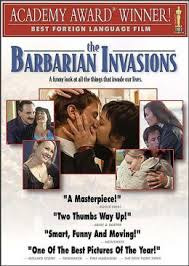
The Barbarian Invasion, Spotlight, Dopesick, Ragnarok, Wuhan, Wuhan, Princess Mononoke, The Boy and the Heron, Spirited Away, Ponyo; Shoei Imamura: Pigs and Battleships, The Story of Narayana,